True ownership cost
What a motorcycle really costs per km, month and year
By Oscar Gallego · Updated
Cost per kilometre is total ownership cost divided by the distance covered over the same period. The division is easy. The result is only as good as what you put into the total and whether both sides of the fraction cover the same stretch of time. To run your own numbers, use the cost per kilometre calculator.
Useful for
Owners comparing what a motorcycle really costs to keep, use, replace, or sell.
Available in Rydger
- Expense ledger: Free
- Cost analytics: Pro
Calculate your cost per kilometre
Enter the ownership costs you want to include and the distance you travelled over the same period.
Fuel per km = L/100 km / 100 x price per litre. Every other category per km = yearly amount / kilometres per year. Total = sum of all lines.
The result is only as complete as the costs you include. Consider fuel, servicing, tyres, insurance, tax, finance, accessories, and depreciation where relevant.
Your values stay in this page. They are not saved or sent to Rydger.
Cost per kilometre calculator →
Choose one period and use it for both sides
The spending and the distance must start and end on the same dates. One month is easy to measure and easy to be fooled by: it can hold an annual insurance payment and no servicing, or a big service and two weeks of rain. A full year absorbs the seasons and catches costs that arrive once. AAA builds its yearly car-cost figures on the same idea, a fixed assumption of 15,000 miles a year over five years.
- Fix a start date and an end date, and use them for both the spending and the distance.
- Take the odometer reading at the start. If you never recorded one, use the earliest reading you can evidence and say the figure begins there.
- Subtract the start reading from the end reading. That is your distance. Read it off the odometer instead of working it out from memory.
What goes in the total
AAA splits the cost of running a vehicle into six categories: fuel, maintenance and repair and tyres, insurance, licence, registration and taxes, depreciation, and finance charges. It treats the last four as fixed costs and the first two as variable. That list is a reasonable starting point for a motorcycle. Decide which lines apply to you, then use the same set every time you recalculate. Two figures built from different lists cannot be compared.
- Fuel.
- Scheduled servicing: labour, oil, filters, plugs, fluids.
- Wear parts replaced outside a service: chain and sprockets, brake pads, discs.
- Tyres. They arrive as one large payment and are easy to forget in the next year's total.
- Insurance, and any circulation or road tax where you live.
- Roadworthiness testing and the fees around it.
- Riding gear and accessories you would not buy without the bike.
- Parking, garage or seasonal storage.
- Finance interest, if you pay any. Count only the interest, because the rest of the instalment repays what you borrowed.
- Depreciation, which gets its own section below.
Cash cost and full cost answer different questions
Keep two figures. Cash running cost is what left your account during the period, and it answers budget questions. Full cost adds depreciation and finance interest, and it answers keep, sell or replace. The cash figure always looks better. Quoting it when you are deciding whether to replace the bike is how owners talk themselves into keeping an expensive machine.
- Work out the cash figure from money that actually moved during the period.
- Work out the full figure by adding depreciation and finance interest to that total.
- Label which one you are looking at each time you write it down or compare it.
Depreciation
Owners skip it because it never shows up on a bank statement, yet it is often the largest line. AAA's analysis counts it among the fixed costs of owning a vehicle for that reason. You can only estimate it, and an estimate you have labelled is more useful than an omission you will forget you made.
- Take what the motorcycle was worth at the start of the period and what it is worth at the end. The difference is that period's depreciation.
- Value it the way you would sell it: what comparable bikes are currently advertised for. Ignore what you paid and what you hope to get.
- A private sale and a dealer trade-in give different numbers. Pick the one that matches your real plan and keep it across periods.
- If the figure is big enough to change your decision, run it twice, once with a pessimistic value and once with an optimistic one, and see whether the decision moves.
- A bike you have owned for many years may lose very little value in absolute terms. That is a real result.
Getting the distance right
The distance is the half of the fraction that fails quietly. A cost per kilometre built on a guessed distance measures nothing, and it looks just as precise as a good one.
- Use odometer readings. Do not multiply your commute by working days.
- If the odometer was replaced or corrected during the period, split the period at that point and treat the two parts separately.
- Distance covered on another vehicle does not belong in this figure, even if you paid for it.
Reading the number
Cost per kilometre falls as you ride more and rises when the bike sits, because a large share of the total is fixed. That is what makes the figure useful and what makes it easy to misread.
- Compare your own figures across periods only when the category list and the cost type (cash or full) are the same.
- Be careful comparing with someone else's number. You rarely know what they included, and two owners' lists usually differ more than their motorcycles do.
- A jump right after a major service is usually timing. Over a longer window it evens out.
- To compare against a car, public transport or not owning a vehicle, use the full figure.
When to recalculate
Recalculating after every fill-up produces noise. Recalculating only when you sell gives you a number too late to act on.
- Recalculate after any expense big enough to move the total.
- Recalculate once you have covered enough extra distance that the distance has moved as well as the spending.
- Recalculate before any keep, sell or replace decision, using the full figure.
Sources
Turn individual expenses into a ledger
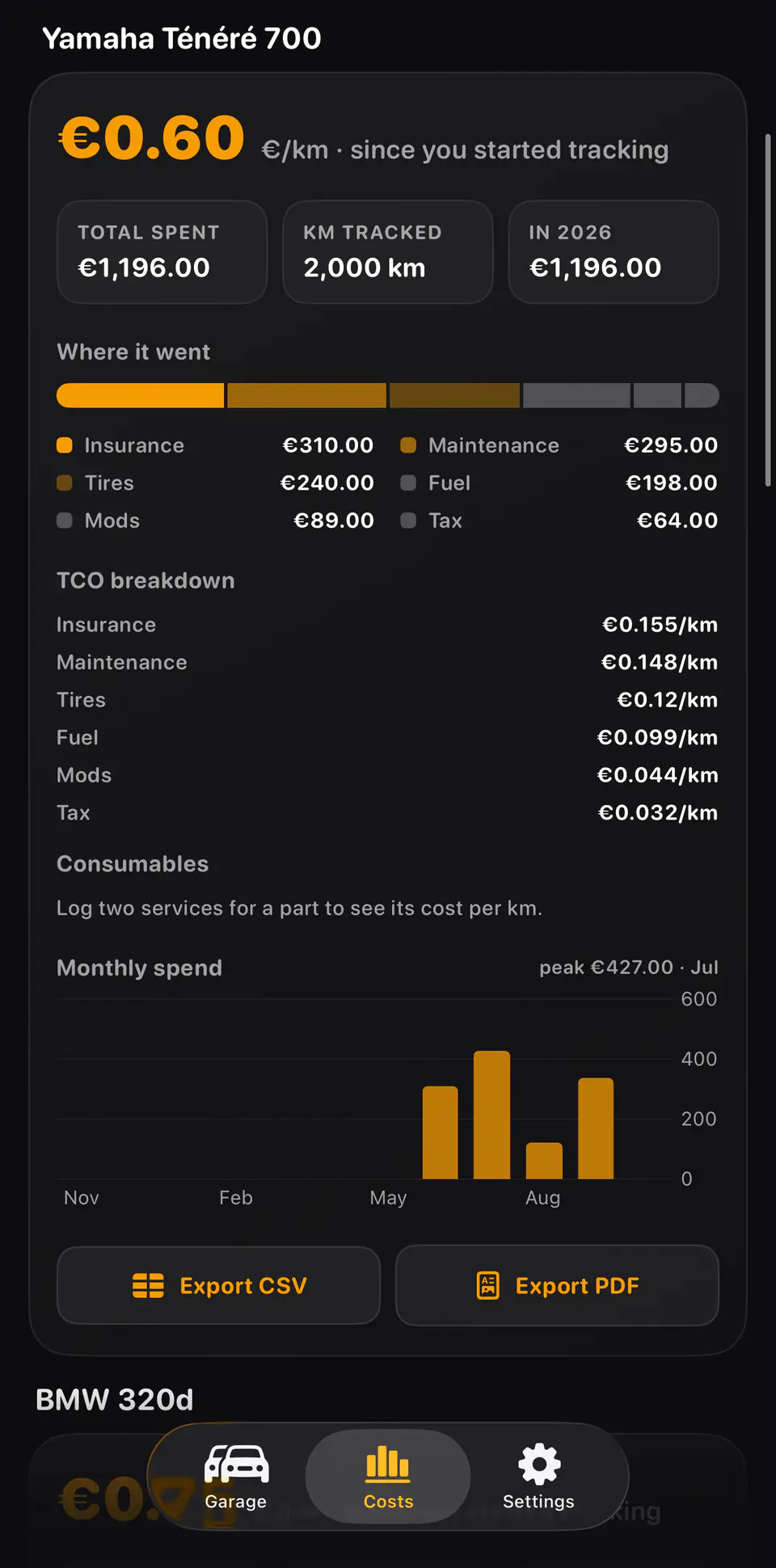
Rydger's Free plan records expenses and keeps the odometer current for one vehicle, and exports your full history to CSV. Pro adds cost-per-distance analytics and category breakdowns inside the app.
Download on theApp Store