Seasonal storage
How to winterize a motorcycle: winter storage checklist
By Oscar Gallego · Updated
To winterize a motorcycle, deal with five things before you park it: the fuel, the battery, the oil, the tyres and the place it will sit. Can-Am, Battery Tender and ADAC agree on those five and disagree on some details, so each step below says who recommends what. The page also covers the deadlines that keep running while the bike sits and the checks before the first ride. Your manual's storage instructions come first wherever they differ.
1.Decide where it will stand and what you are protecting against
Two months in a dry, ventilated garage and two months under a cover in a damp yard are different problems, and neither is the same as three weeks between trips. Decide the conditions first, because they determine which steps matter.
- How long: a few weeks mostly means looking after the battery. Several months brings in fuel, tyres and corrosion.
- How damp: moisture and condensation drive corrosion more than cold does. Can-Am recommends a climate-controlled space between 10 and 20 °C with moisture absorbers.
- Whether the temperature swings: a space that warms and cools repeatedly can condense moisture onto cold metal.
- Whether you can visit the bike: if you can, periodic checks replace some of the preparation. If you cannot, prepare for the whole period at once.
- Where it stands: ADAC asks for a dry, well-ventilated cellar or garage that is not too warm.
2.Clean, dry and inspect it while you can reach it
Do the work before the bike is boxed in behind other things, and while it is clean enough to inspect. It is also your last easy chance to find a leak or a worn part. ADAC says to clean the bike completely and dry it well. Battery Tender advises washing the bike thoroughly and waxing paint and metal, and Can-Am adds anti-corrosion spray on exposed parts such as the exhaust.
- Clean and dry the motorcycle completely. Trapped moisture and road salt do more damage than the winter itself.
- Inspect it while it is clean: look for leaks, damaged surfaces and perished rubber.
- Protect exposed metal and finishes the way the manufacturer recommends for your machine.
- Note the odometer and the date the bike goes into storage, so the record has a clear start.
3.Fuel and oil
For fuel, the right answer depends on the fuel system and the tank. Can-Am says to fill the tank, add a fuel stabilizer and run the engine so the treated fuel reaches the whole system. Battery Tender says to top the tank off: there is less room for condensation, and fuel left standing can leave varnish and gum that make spring starts harder. ADAC answers by tank material instead: a metal tank full to the rim, a plastic tank as empty as possible because fuel components can diffuse through the wall. On a carburetted bike, ADAC adds that the float bowls can be emptied through their drain screw, or by closing the fuel tap before the last shutdown. On oil the sources agree. Can-Am says used oil carries contaminants that can harm the engine during a long lay-up, and ADAC says to drain a four-stroke's oil while warm, replace the filter and refill before storage. Where any of this differs from your manual, follow the manual.
- Check your manufacturer's storage guidance on fuel level and on draining anything. Different machines get different instructions.
- If a stabilizer suits your machine, add it and run the engine long enough to circulate it, as Can-Am describes.
- If the oil change would fall due over the winter anyway, do it before the bike goes into storage.
- Write down what you did. You will not remember in spring, and recommissioning depends on it.
- Follow the safety instructions for handling fuel and for running an engine in an enclosed space.
4.Battery
A battery left connected to a modern motorcycle drains slowly, and a deeply discharged battery can be damaged for good. Can-Am says to remove or disconnect the battery, or keep it on a battery tender. ADAC says to take it out and keep it somewhere dry, cool and frost-free, and to charge it from time to time. Battery Tender, which sells chargers, advises cleaning the terminals and then connecting a maintainer. The charger has to suit your battery's chemistry.
- Find out what chemistry your battery is before you choose a charger or maintainer.
- Use a maintainer the manufacturer states is suitable for that chemistry, and follow its instructions for connection.
- If your manufacturer says to remove the battery, do that instead of improvising.
- Record what you did, so you know what to expect when you recommission the bike months later.
5.Clean and lubricate the chain
ADAC says to clean the chain and sprockets with a chain-cleaning kit and then oil the chain with chain spray. If your bike has a shaft or belt drive, follow the manual instead.
6.Tyres and support
The issue is weight resting on one spot for months. Can-Am says to inflate to the recommended pressure and take the weight off with lifts or stands, or rotate the tyres from time to time if you have no stands. ADAC suggests about 0.5 bar above normal pressure for a long stand. Set the pressure back to the manual's value before you ride.
- Set tyre pressures before storage instead of letting them drift down for months.
- Use stands or other support where that is safe for your machine.
- Keep tyres off cold bare concrete and out of damp if the surface allows an alternative.
- If you can visit the bike, move it slightly now and then so the contact patch changes.
- While you are down there, read the four-digit date at the end of each tyre's DOT code, so you know how old they are before spring. The tyre date code checker turns it into an age.
7.Cover it
ADAC warns against an airtight plastic sheet, because condensation collects underneath it, and suggests a cover made from a blanket or cloth instead. Use the cover over a clean, dry bike, so it does not trap moisture against the paint.
8.Check the insurance and registration
Insurance keeps running while the bike sits, and changing it can change what the registration allows. In the UK, for example, GOV.UK says you must insure and tax a vehicle unless it has a SORN, and a vehicle with a SORN may not be kept on a public road. The rules differ by country, so ask your insurer what a change does before you make it.
9.What keeps running while the bike sits
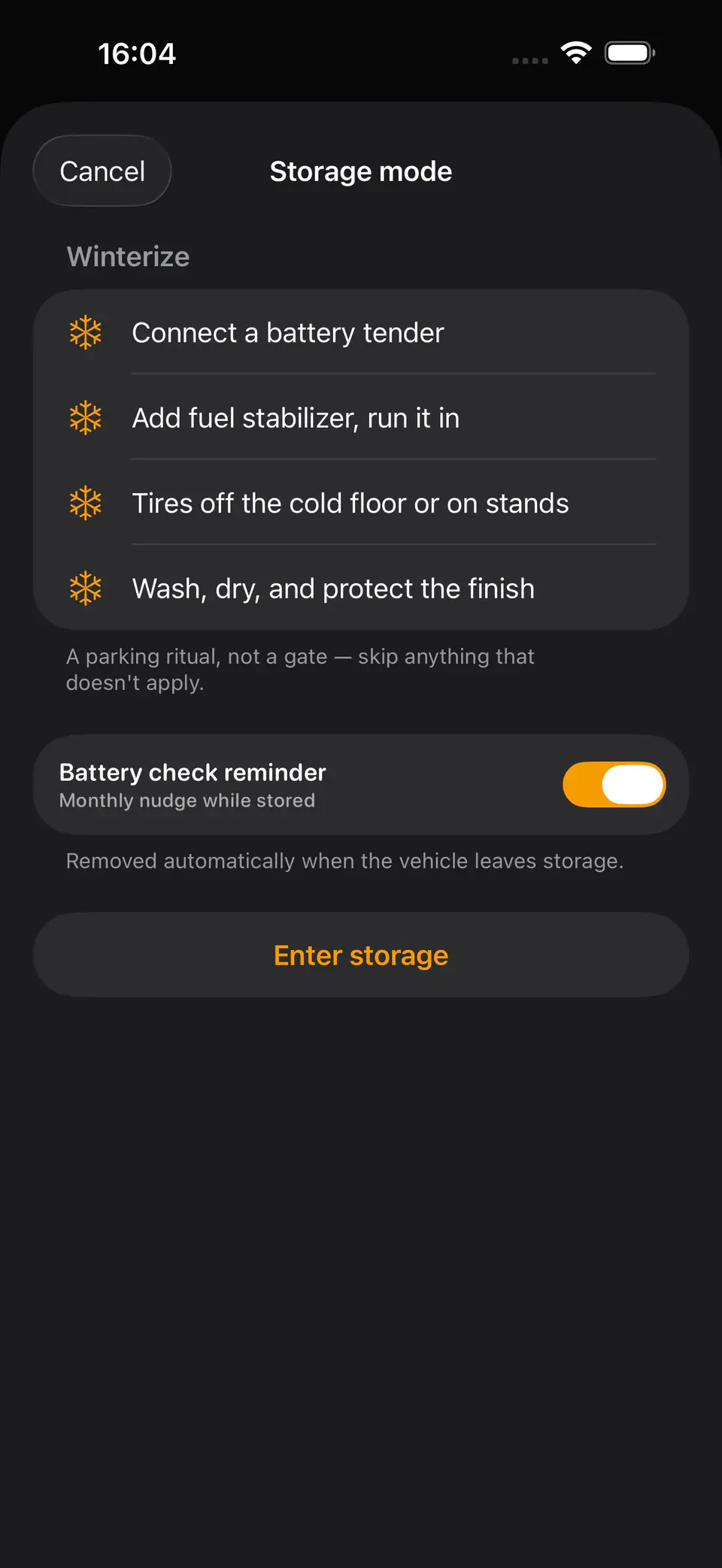
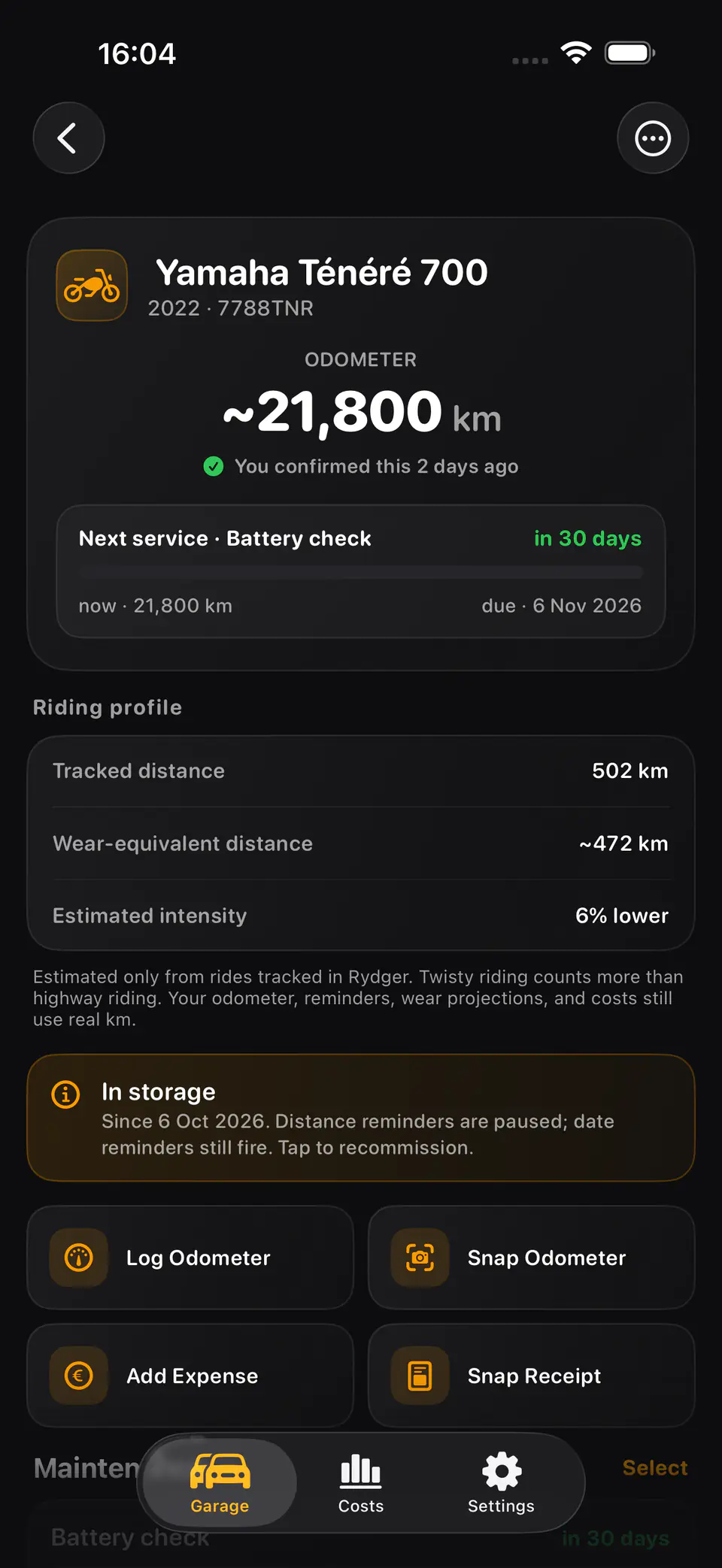
Storage pauses wear. It does not pause the calendar, and many obligations run on dates alone. The Storage Mode guide shows which reminders Rydger keeps running while the bike is parked.
- Roadworthiness tests fall due on their own schedule.
- Documents expire on their own dates.
- Fluids with an age limit keep ageing. ADAC puts the brake fluid limit at two years regardless of mileage.
- Tyres keep getting older. Michelin recommends a yearly professional inspection from five years of age and replacement at ten.
- An item with both a date and a distance limit may now be due on the date even though the odometer has not moved.
10.Recommission before you ride
The first ride after storage is the most likely to expose a problem, so do the checks with the bike standing still and leave yourself the option to stop.
- Check fluid levels and condition, tyres and pressures, controls and cables, lights, and the chain or final drive.
- Look at the floor where the bike stood. Anything that leaked in storage left a mark.
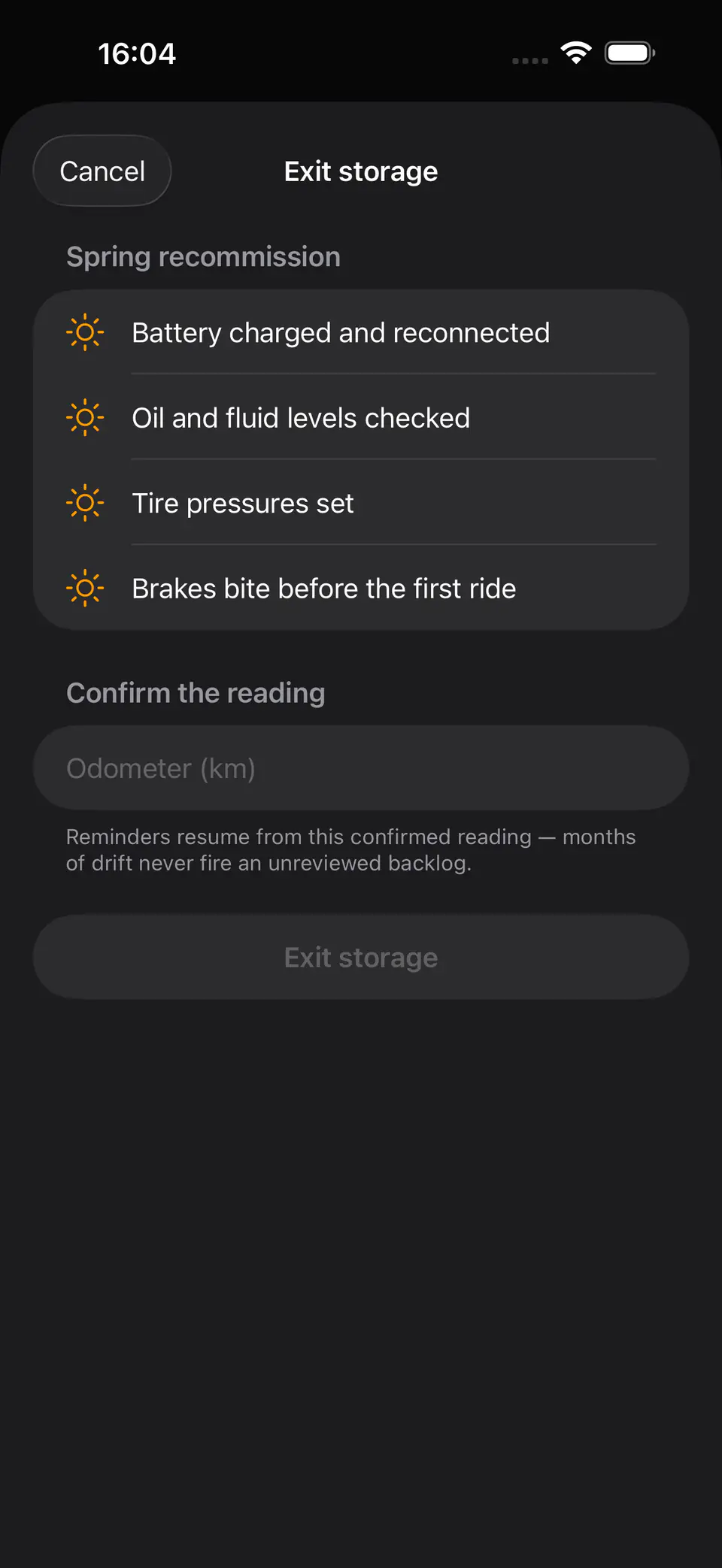
- Reconnect or refit whatever you removed, restore normal tyre pressures and confirm the odometer reading.
- Check the brakes build and hold pressure before you set off, and take the first few minutes gently.
- Review the date-based maintenance and legal deadlines that came due while the bike sat, and deal with them before planning any distance.
11.Record the storage
A stored period is a gap in the record. Unexplained, it looks the same as neglect to a future buyer, and to you.
- Record the dates in and out, the odometer at both ends and the preparation you did.
- Record anything you put off until spring, so it carries forward.
- When the bike is back in use, confirm the distance schedule resumes from the right reading.
Useful for
Riders parking a motorcycle for weeks or months in cold or damp conditions.
Available in Rydger
- Storage Mode: Pro
Storage Mode in Rydger (Pro)
Sources
Track the storage as well as the bike
Rydger Pro Storage Mode guides preparation and recommissioning, pauses wear-based reminders while the bike is parked, and keeps calendar deadlines active so nothing expires unnoticed.
Download on theApp Store